

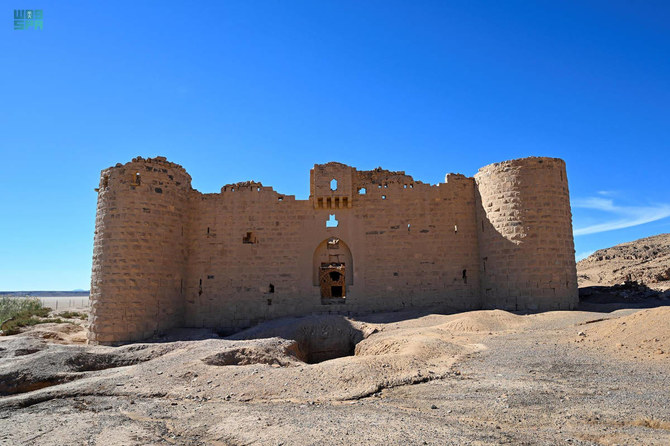
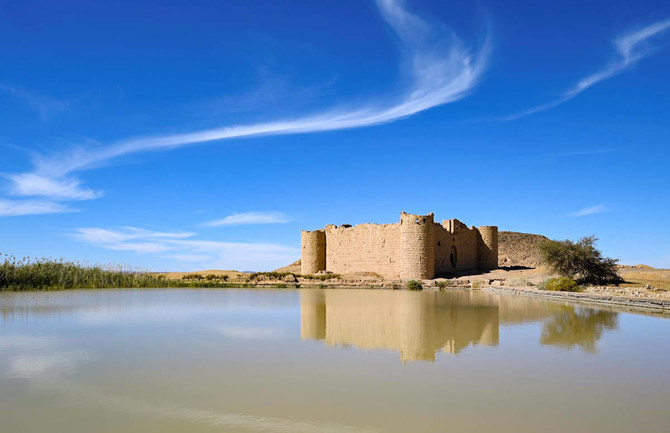
Explore the captivating Al-Muazzam Fort nestled in Tabuk, a masterpiece echoing the brilliance of Islamic design and the late Islamic period’s dedication to aiding pilgrims on the Levant trail.
Founded in 1031 A.H. (1622 A.D.), this fortress wasn’t just a resting haven for pilgrims and Umrah goers; it stood as a protective sentinel, guarding the routes to and from Madinah and Makkah.
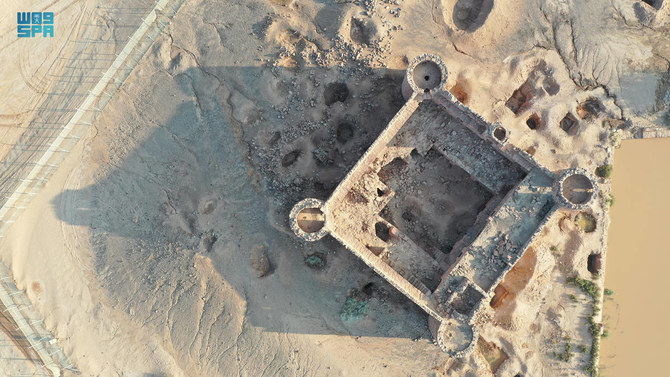
Spanning an impressive 10,000 square meters, its sturdy rectangular walls whisper tales from over four centuries. At its heart lies a vast courtyard, encircled by intricate rooms, stairways, and elevated pathways.
Crafted meticulously with refined stones, the two-story structure stands tall, crowned with a defensive wall mirroring the height of its inner passageway. Its facades, robust and windowless, boast tiny apertures, remnants of its formidable defense mechanisms.
Discover the allure of its features like the serene Al-Muazzam pond and the historic Hijaz railway station. Constructed from striking reddish-yellow stone, the fort proudly showcases four foundational inscriptions, each telling a story.
A grand entrance beckons visitors with its majestic arch and strategic defensive designs. Over the years, Al-Muazzam Fort has welcomed famed explorers like Germany’s Julius Oetting and France’s Charles Huber in 1301 A.H. (1884 A.D.), immortalized in the enthralling book, “A Journey in the Arabian Peninsula.
